Custom letterpress menu card with green and gold impressing for a Western food restaurant

Letterpress vs Foil Stamping: How to Choose the Right Finish for Your Paper Cards

Choosing between letterpress and foil stamping is the single decision that most changes how a printed card feels in the hand. Both put a finish on the same sheet of paper, and both can carry the same logo — but one sinks the design into the surface and the other lays a metallic film on top of it. This guide explains what each process actually does to the paper, what it costs, and which projects suit which finish.

The short answer

✅ Choose letterpress when you want the customer to feel the print: thick uncoated cotton stock, one or two colours, a logo or name that reads as craft rather than shine.

✅ Choose foil stamping when you want the design to catch light: gold, silver, black or holographic film on cards, hang tags and invitations that need to look premium from across a room.

✅ Choose both when the budget allows — a letterpress impression with a foil hit on top of it is the combination most luxury stationery brands use.

Angled detail of debossed letterpress logo showing paper depth and texture

What letterpress does to the paper

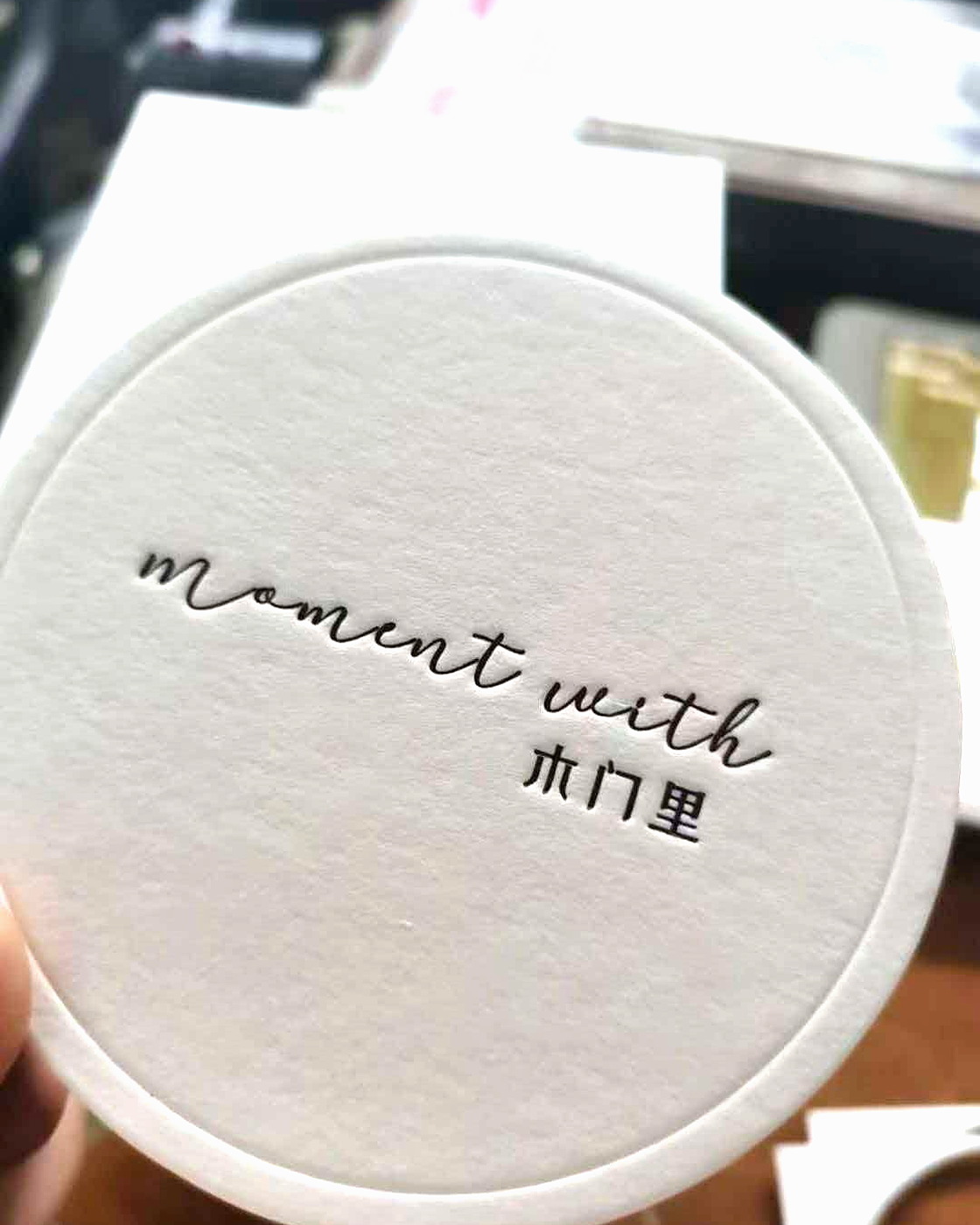
Letterpress is a relief process. The plate is raised, ink sits on the crest of the plate, and the press drives it into the sheet hard enough to leave a permanent impression, so the type ends up sitting in a shallow trough with a lit wall on one side of every letter and a shadow on the other. You can feel it with a thumb before you read it.
That impression is why paper choice matters more than artwork in letterpress. A coated card takes the ink happily and then cracks along the impression line when the press bites, while thick uncoated cotton compresses instead of breaking, so the depth of the impression holds from the first sheet to the last. It is also why letterpress is usually run in one colour: each additional colour is another pass through the press, and a single-image plate is far easier to keep consistent.
Round cotton paper coaster with a deep letterpress impression of a handwritten script brand line and a short Chinese brand name below it

What foil stamping does to the paper

Foil stamping uses heat and a metal die to transfer a thin metallic film onto the surface of the sheet. Nothing is pressed in unless you ask for it — the foil sits slightly proud of the paper and reflects light, which is exactly the point. Gold and silver are the standard options, but black foil on black card and holographic film that shifts colour with the viewing angle are both workable on the same equipment.
Because the die is cut to your artwork, fine hairlines and very small type are the risk areas: below roughly 6 pt, or on strokes thinner than about 0.3 mm, foil can fail to release cleanly. Solid shapes, bold logos and medium-weight type give the best result.
Close-up of silver hot foil stamping on textured black cardstock, showing the metallic foil surface and die edge

Cost, minimum quantity and lead time

Set-up. Both processes need a plate or die made from your artwork. Letterpress uses a polymer plate, foil stamping a metal die; the die is the more expensive of the two, so foil carries a higher one-off cost on the first order and almost no cost on reorders.

Run cost. Letterpress is slower per sheet and needs makeready time to hit impression depth, so on long runs foil is usually cheaper per unit. On a short run the plate cost dominates and the two are closer than most buyers expect.

Minimum quantity. Neither process requires a large run. We run both from a low minimum, which is the practical way to test a finish before committing to a full launch quantity.

Lead time. Artwork approved today, quote back within 24 hours. Tell us the finish, the stock and the quantity and we will confirm a delivery date at the same time.

The same holographic black card shot from three angles, the foil shifting from blue and green to pink and gold

Which finish fits which product

Cards and business cards — letterpress on cotton stock if the brand is built on tactility; foil if it is built on shine. See our letterpress cotton paper cards.

Hang tags — foil survives handling and packing better, and reads clearly on a dark garment tag. Black-on-black foil tags are a good example.

Coasters — letterpress, because the impression stays legible even when the surface is wet. Letterpress cotton paper coasters.

Paper badges — letterpress, because the badge is light and the impression gives it presence without adding weight. Letterpress paper badges with pin back.

Can you combine them?

Yes, and it is worth doing at least once. A blind or inked letterpress impression followed by a foil hit on the same sheet gives you depth and reflection together — the foil sits on the raised shoulder of the impression and picks up light from two directions. The two processes are registered to the same guide, so alignment is not a problem, but the sheet has to be thick enough to take both without showing the impression through to the reverse side.

Get a quote

Send us your artwork, the card size, the stock you have in mind and the quantity. We will tell you which finish suits the job, quote within 24 hours, and confirm the delivery date. Request a quote.
Shopping Cart