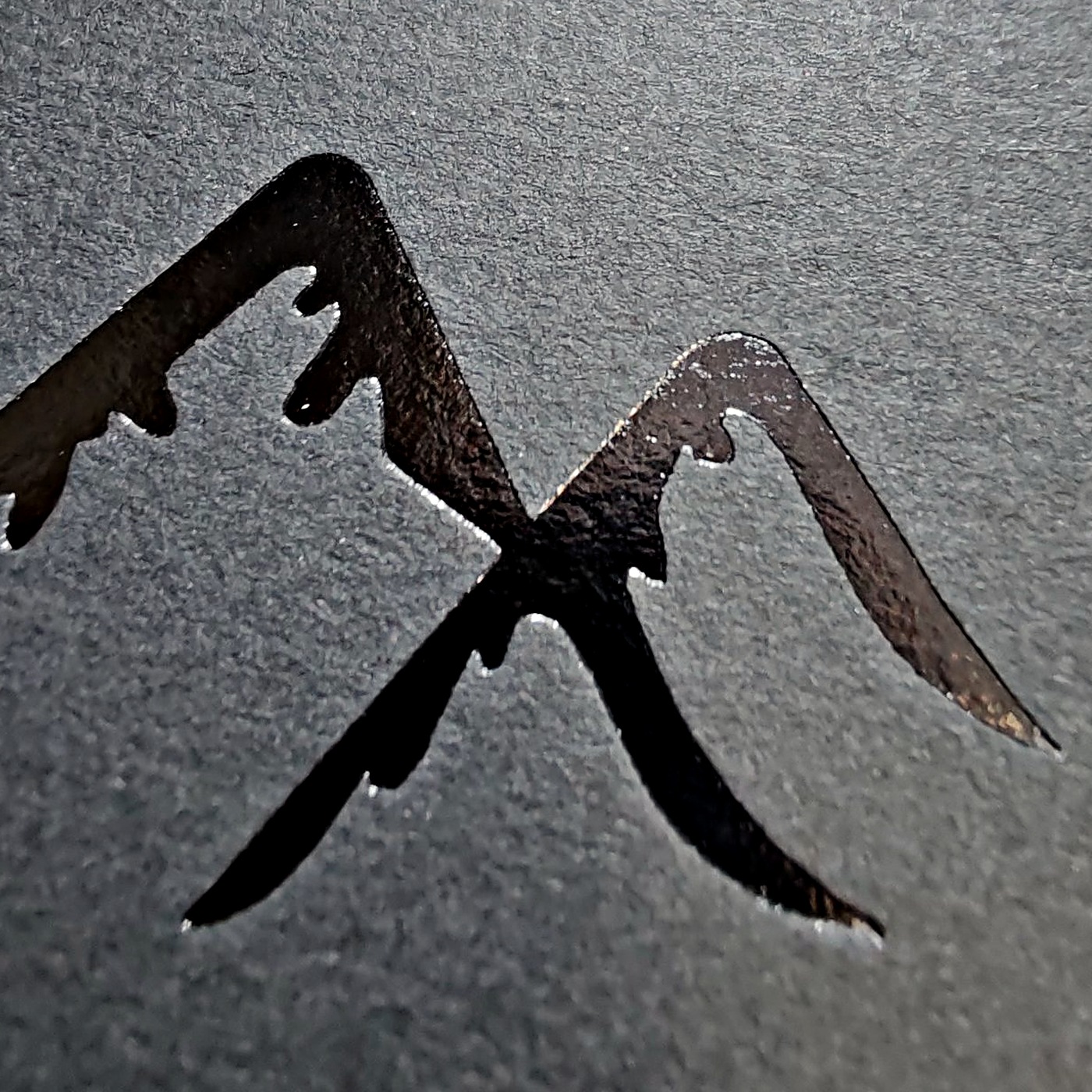
Blind deboss and foil stamping solve the same problem in completely opposite ways. Both put a logo on paper without adding printed colour, both read as “expensive” to a customer, and both cost roughly the same on a short run. But one of them disappears the moment the light is flat, and the other disappears the moment the surface gets scuffed. Knowing which is which will save you a bad reorder.
The difference in one sentence
Blind deboss uses no ink and no foil. A metal die presses the artwork down into the sheet, and you see the design only because light falls across the raised edge of the impression. It is a shadow, not a colour.
Foil stamping uses heat and a die to transfer a thin metallic film onto the surface. Gold, silver, black, holographic — the film is what you see, and it reflects regardless of how flat the light is.
What blind deboss does to the paper
“Blind” simply means no ink. The press squeezes fibres together under heat and pressure, so the paper itself becomes the artwork. It works best on thick, soft, uncoated stock — cotton paper especially, whose long fibres compress and stay compressed instead of springing back. On thin or coated board the impression is shallow and looks like a crease rather than a design.
The trade-off is that blind deboss has very low contrast. Under a shop spotlight it is striking; laid flat in a dim room it nearly vanishes. That is not a defect, it is the aesthetic — but it means blind deboss is a poor choice for anything that must be read quickly from three metres away.
What foil stamping does to the paper
Foil sits slightly proud of the surface and reflects light, so it stays legible in flat lighting. It also gives you a second colour dimension: silver on black card reads very differently to black foil on black card, and holographic film shifts through several colours as the viewing angle changes.
Foil’s weakness is fine detail. Below about 6 pt type, or on strokes thinner than roughly 0.3 mm, the film can fail to release cleanly from the die. Solid shapes and medium-weight lettering are safe; hairlines are not.
How each finish survives real handling
Scuffing. Foil is a surface film, so it can be scratched by hard, repeated abrasion — think tags rubbing against each other in a carton on a long shipment. A debossed impression cannot scratch off, because there is nothing on the surface to lose.
Crushing. Debossed impressions can flatten under sustained heavy pressure. On thick cotton stock this is rare, and the impression recovers, but it is worth knowing before you deboss something that will sit at the bottom of a box for six months.
Moisture. Both survive normal humidity. Foil is marginally better on coasters that see condensation; both are fine on hang tags.
Both sides. A deep deboss leaves a visible bump on the reverse of the sheet. If you need writing or care instructions printed on the back, plan the layout around it — or use foil, which leaves the reverse flat.
Folded cards and invitations — blind deboss, because a card is read at arm’s length where the shadow is obvious.
Shaped and die-cut pieces — either works, but register the finish to the shape carefully. Our rose-shaped tags use blind emboss so the shaping stays the hero.
Coasters and anything wet — go with pressure rather than film where you can.
The mistake worth avoiding
The most common failed reorder is buying blind deboss on thin board. On a light, coated sheet the impression is so shallow that half the shipment looks unprinted, and there is nothing to fix after the fact. If you want blind deboss, budget for heavier stock — 400 gsm and up, uncoated. We explain why in our paper weight guide.
Get a quote
Send the artwork, size, stock and quantity and we will tell you honestly which finish suits the job. Quote within 24 hours, factory direct, low MOQ. Compare it with letterpress, the third option, or just ask us directly.